
New to his post at Juddmonte Farm in Kentucky, Irishman Garrett O’Rourke walked out to a field to check on some broodmares. They stopped him in his tracks.
“My God, look at them,” he thought. “I could see myself going down to Becher’s Brook looking between the ears of these mares.”
O’Rourke never told anyone about his thoughts of glory in the Grand National at Aintree – definitely not the goal – but the point remains. Juddmonte’s mares, even in 1992, brought substance and both a literal and figurative foundation to owner Prince Khalid Abdullah’s racing operation that was relatively young when O’Rourke took the job. Now the manager of the Kentucky farm, O’Rourke gets reminded of those early days frequently – and especially with the recent success of Grade 1 winners Segesta and Salamis and their half-sister Directive who runs in today’s Grade 1 Coaching Club American Oaks.
Their fifth dam, Lost Virtue, was in that field.
“They were big with great bone, size, scope,” O’Rourke said. “Lost Virtue was a lovely stamp of a mare, a great big gray mare. You start with something like that and it makes the matings easier; it makes everything easier.”
A foal of 1977, Lost Virtue was bred by Pen-Y-Bryn Farm, a daughter of Cloudy Dawn and the Tulyar mare Aunt Tilt. Cloudy Dawn’s pedigree went back to historic Thoroughbreds Blenheim, Black Toney, Whisk Broom and Blue Denim. In addition to the influential Tulyar, a source of stamina and durability, Aunt Tilt was a half-sister to 1967 Horse of the Year Damascus and traced to Nearco, Phalaris and Blue Larkspur. Lost Virtue sold to Herbert Hill for $36,000 as an unraced 3-year-old at Keeneland January in 1980. She had her first foal, future stakes winner Full Virtue, the next year. By 1986, she’d produced two more foals to race (one a Group 3 winner in France, the other a two-time winner at Laurel Park) and went to Keeneland November as part of the Mill Ridge Farm consignment.
Then just seven years removed from buying its first broodmare and six from acquiring its first Kentucky farm, Juddmonte paid $375,000. The Topsider foal she was carrying, Doubtful Motive, started 126 times (winning 14) in France. Lost Virtue’s 1989 foal, a daughter of Riverman named All At Sea, won the Group 1 Prix du Moulin at Longchamp for Juddmonte and Henry Cecil.
Lost Virtue (also the third dam of 1998 champion 3-year-old filly Banshee Breeze) produced nine winners in all and continues to impact the fortunes of Juddmonte through branches of her family tree.
All At Sea’s daughter Imroz won three races in Britain and placed in an American Grade 3 for Bobby Frankel. Among Imroz’s foals was Ixora, who never raced but produced Antonoe, a Group 3 winner in France and a Grade 1 winner in the United States.
Third in the 2017 Diana at Saratoga, she followed her ancestors to the Juddmonte broodmare band. Her first four foals to race are allowance winner Catmint (by Kitten’s Joy), dual Grade 1 winner Segesta (Ghostzapper), Grade 1 winner Salamis (Speightstown) and Saratoga allowance winner Directive (Gun Runner), the 6-1 fourth choice in the CCA Oaks. A 2-year-old full-sister to Salamis, Bridgetown Rose, was breezing at Saratoga but just returned to Juddmonte for a break.
A daughter of Juddmonte’s First Defence, Antonoe does not necessarily stamp her foals.
“Segesta is a pretty mare, not over big, just a nice middle of the road physical,” said O’Rourke. “Salamis is a bigger colt with muscle and bone. Directive was born really tall and really narrow and gangly and has taken awhile to come to hand. The 2-year-old’s got size and is a nice blend of Speightstown and the mare, but you wouldn’t say she looks like any of the others. You could put all of them side by side by side and say they’re not related.”
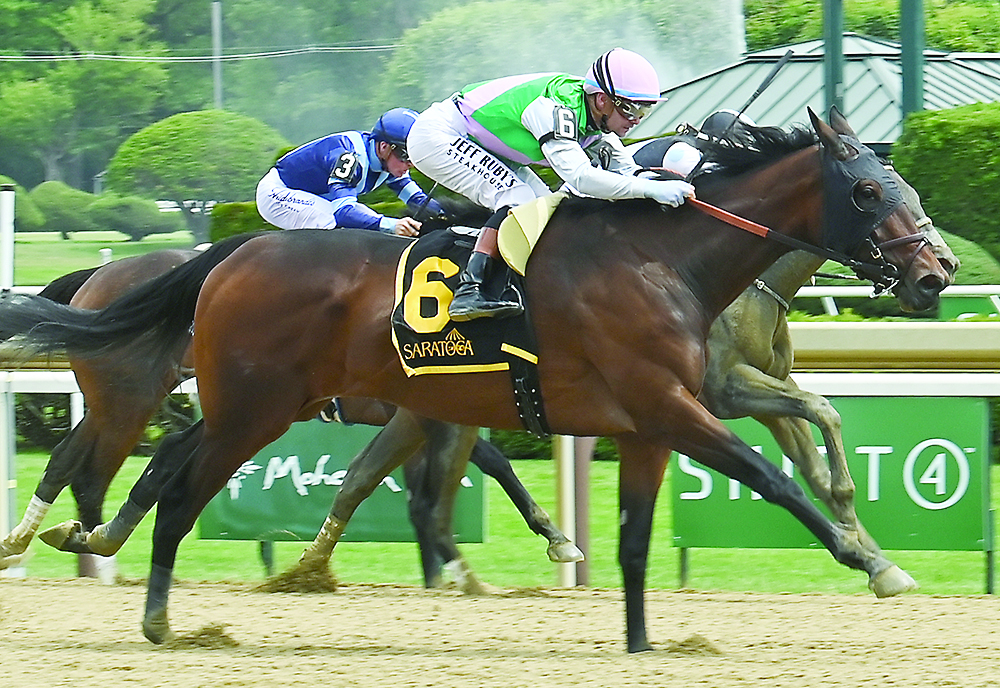
Salamis and Segesta run on the turf, like Antonoe. Directive sticks to the dirt. A Justify colt, born this year, waits his turn. His mother is in foal to Vekoma for 2027.
O’Rourke drew a parallel to Juddmonte stalwart and 2002 Broodmare of the Year Toussaud, whose diverse foals included Arlington Million winner Chester House and Belmont Stakes winner Empire Maker.
“Sometimes they’re good mares because they allow the genes to fall in the right place without stamping them one way or the other,” said O’Rourke. “You shrug your shoulders and just learn that’s the way it is.”
For all its success Juddmonte, overseen by Prince Khalid’s family after his death at 85 in 2021, holds no special cards when it comes to Thoroughbred production.
Team members in Kentucky, England and Ireland do the best they can, over and over. The young horses stay with the farms until they’re ready to go to trainers so Juddmonte staffers oversee every step in the process – mating plans to foaling, breaking and pre-training to loading the vans en route to trainers.
“Everyone thinks that if you’re Juddmonte, you’ve done something brilliant,” said O’Rourke. “It’s fascinating. Along the way you learn an awful lot of what you don’t know. The beauty of working with multiple generations is you pick up nuances of families. You learn the weaknesses too and try to breed away from them as much as you can even though that doesn’t always work. I think an awful lot of it has to do with what we see every single day. The longer you keep them under your watch, the more you know.”
Lost Virtue knew it all along.
Keep reading…
Click the cover to access the online edition of the full paper, presented by Eclipse Thoroughbred Partners.