By Shea Brown
Picture this. It’s 2018 in Northern Ireland. You look out your bedroom window and see a horse in the pasture behind your house. Your 4-year-old daughter Maeve sees it too and is immediately obsessed.
You go outside and start spending time with the horse. Maeve names it Captain ’Merica and you spend time answering her questions such as, “I’m learning to read in school, but who’s going to teach the horse to read?” and “Well if it’s raining, who’s going to put a raincoat on the horse?”
These outside-the-box questions get you thinking about how a horse experiences the world.
And slowly, an idea starts to form.
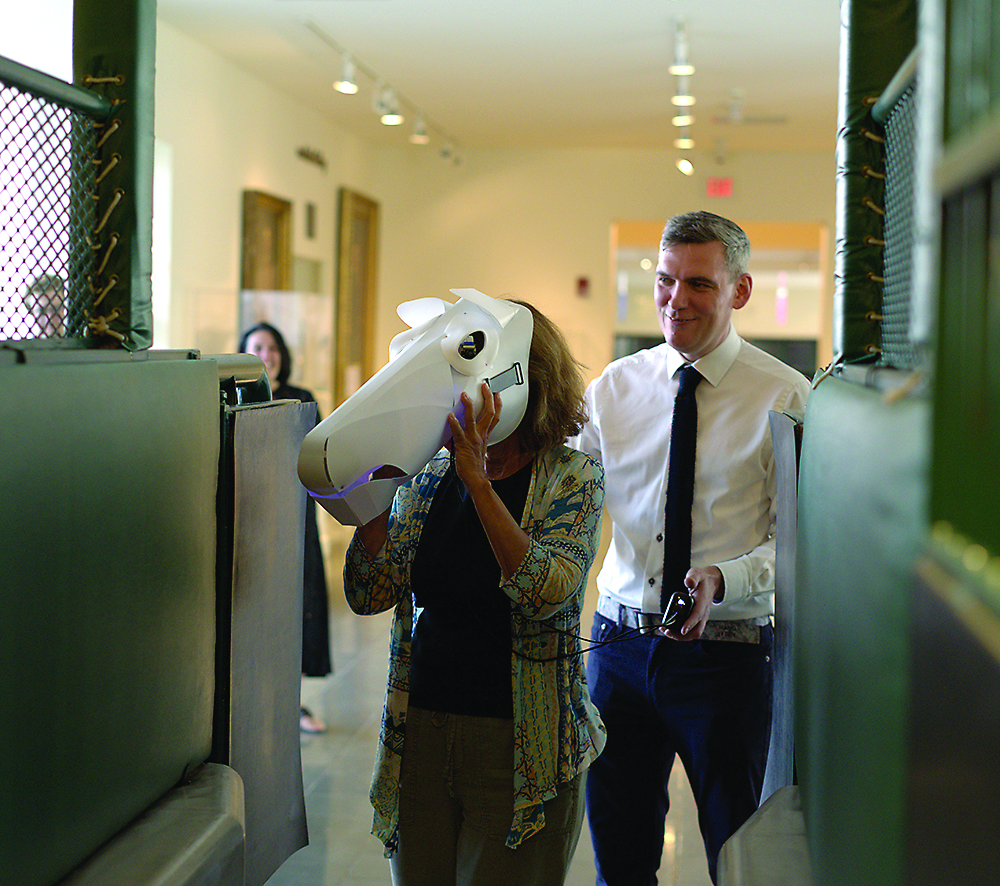
That “you” is Dr. Alan Hook, a senior lecturer at Ulster University in Northern Ireland. Inspired by those conversations with his daughter, Hook created the world’s first interactive exhibit built to simulate how a horse perceives the world. Using a specially designed headset with mounted cameras, individuals are able to experience the world in a way that has never been seen.
The exhibit made its way to Saratoga Springs through funding from the Thoroughbred Education Research Foundation and was unveiled Wednesday at the National Museum of Racing and Hall of Fame, accompanied by a presentation from Hook.
“It’s this idea of becoming more attentive to other species and tuning ourselves to the way they think about the world,” said Hook. “We can know horses and Thoroughbreds in lots of different ways. We can know them through statistics, we can know them through riding, we can be with them day to day. But what might it be like to kind of understand the horse from the inside?”
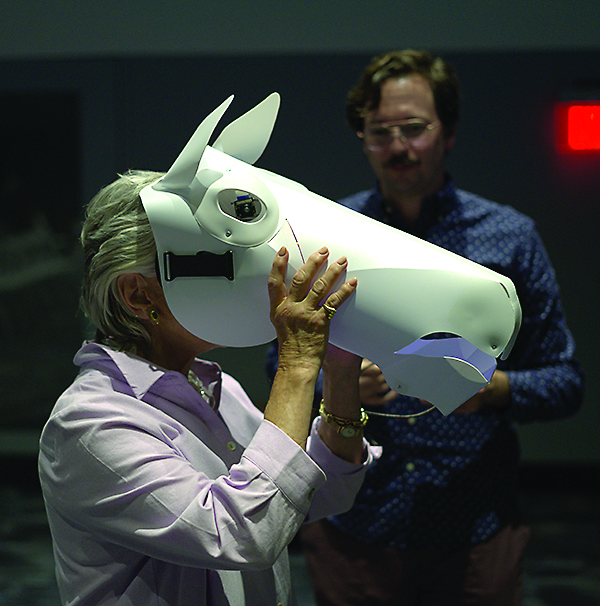
About 30 people attended the event, including former jockey and recently retired NBC Sports reporter Donna Brothers. After the presentation, everyone was invited to try on the invention. Hook prefaced the experience by informing everyone of some basic facts regarding horses’ eyes.
He explained that horses have dichromatic vision, meaning they see between a span of blue and yellow, but can’t see red. Also, horses have about a 350-degree field of vision. And, as many people know from experience – sometimes the hard way – horses have blind spots directly in front of and behind them.
After this brief education, it was time to try on the gear.
As soon as I slipped on the headset, I was disoriented. A colorless and discombobulated version of the world came into focus and it was jarring not being able to see right in front of myself. A group of us went to the starting gate in the museum to see what it might be like for horses when it’s time to load. The most repeated phrase when everyone took off the headset?
“No wonder they don’t want to go in the gate.”
Hook’s goal is to foster empathy across species, and judging by the conversations that followed, the exhibit succeeds. People immediately began wondering how horses perceive everyday situations and how humans might make those experiences easier. For Hook, seeing those conversations unfold is exactly the goal.
“I usually present in museums and in galleries, and it’s usually quite far away from horses with people who don’t really think about horses at all,” said Hook. “So it’s really nice being here and working with people who are already so attuned and can put their ideas to work as well.”
What started with one little girl wondering who was going to teach a horse to read has become an opportunity for people around the world to see life through a horse’s eyes.
Keep reading…
Click the cover to access the online edition of the full paper, presented by Eclipse Thoroughbred Partners.