By Ryan Clancy
Corbin texted me on the last Sunday in April to ask what I had going on the following weekend. I deflected. Weekends are for picking up dog poop, mowing, menial house projects, watching the Orioles struggle, maybe an afternoon at the zoo if everything goes right. I don’t have to ask what he’s doing on the first Saturday in May. He said something about a last-minute cancellation, a couch in a hotel room, and a ticket up for grabs.
Corbin and I have been friends for more than half our lives. I can’t file him away neatly into high school friend, college friend, running friend, or any of my normal categories. We met working a summer job as teenagers. I remember his first day on the job at 15 years old. I had a few months more experience under my belt. It was the last time I ever felt like I knew what I was doing around a horse more than he did. Our boss, trainer Graham Motion, told me to be a friend to Corbin and look out for him. Simple enough instructions. We were English-speaking kids in high school, attributes that set us apart in the workplace.
Corbin dove headfirst into racing from there. He got a B.S. in Equine Science and Management from the University of Kentucky and strung together a series of internships and jobs around the world, building a resume and connections that would take him anywhere he wanted in racing. I remain a fan of the sport who likes to be around the big animals, tradition, and the occasional wager.
I ended the call Sunday night wishing him good luck the following Saturday. We’d be watching from the couch, just like last year, and the year before. Maybe I’d make the Preakness if I could find a babysitter. I got back to eating dinner and trying to remember which life obligations were supposed to be stressing me out. I expressed to Ilana how it felt to turn down the offer, and whether it was bad to wish you didn’t get the offer at all. Ilana urged me to reconsider. She (correctly) pointed out that it was a once in a lifetime offer and reminded me how much the day means to Corbin.
I guess it couldn’t hurt to check the flight situation, just to reinforce the decision to stay home. It’s probably easier to hit the superfecta in the Kentucky Derby than to find a convenient flight just five days before it. It wasn’t that I didn’t want to go, I just wanted to be proven right that my life was too full of logistics, schedules, and responsibilities to get away on short notice; to know it was OK to feel stressed and consumed by fatherhood and content to keep plugging ahead with business as usual. I hadn’t left the state of Maryland in the eight months since becoming a father and was feeling immovable.
But there was a flight, an airport 15 miles from me, and another one even closer to Churchill Downs. There was a credit in my Southwest account from a wedding flight we had to cancel when Ilana went into early labor last September. More importantly, there was a gracious wife urging me to accept the offer and reassuring me she had things under control. I checked the weather forecast for good measure and texted Corbin back.
Corbin Blumberg is the general manager of Starlight Racing, an ownership group that probably wants to win the Kentucky Derby more than anyone else in racing. They’ve done it twice in the last ten years, but they’re still hungry. He bought derby contender Fulleffort for $425,000 at the Saratoga Select Yearling Sale in August 2024 on behalf of the group. A large sum of money by most reasonable standards, but far from the most expensive purchase at the sale.
I called Corbin Monday morning on the way to work to confirm the plan. Given the logistical challenges of the last eight months and adjusting to life as a father, I felt incredulous that it could really be as simple as putting my suit in a bag and getting on a flight. I let him know how much it meant to be included and hoped he’d forgive me for being initially dismissive of the idea.
Fulleffort won for the first time as a 2-year-old in September 2025 at Kentucky Downs, an all-turf racetrack strategically placed along Kentucky’s southern border with Tennessee. He went on to win at Keeneland later that fall and was second-best twice at Ellis Park, all on the turf. He won the Jeff Ruby Steaks, a three-quarter-million dollar three-year-old stake race, punnily named for the presenting sponsor: a steakhouse with locations across Kentucky, Tennessee, and Ohio. The Jeff Ruby Steaks is unique for being the only major American Kentucky Derby prep race on a synthetic track. The track is made from sand, silica, and synthetic fibers, creating a softer, weather-resistant racing surface that suits some horses better than others. Fulleffort’s best effort occurring over a synthetic surface was an ambiguous data point for handicappers looking for angles.
The motley crew assembled to root on Fulleffort included Corbin’s mom, Bridgit, and girlfriend, Katelyn. We spent the next few days ironing out plans for the weekend and logistics for the weekend. Fulleffort trained well over the Churchill Downs dirt all week.
I was awake in bed Thursday morning earlier than I wanted to be, dwelling on what I’d need to do at home to be ready for the weekend. I heard my phone buzz at 5:30 and reached for it. Fulleffort had been scratched after a scan of his ankle revealed a small piece of misplaced cartilage, commonly known as a chip, in his hind ankle. Corbin had some tough phone calls to make.
Bone chips are relatively common occurrences in racehorses. While they can be easily identified thanks to advancements in veterinary science, it’s nearly impossible to diagnose whether they are caused by an injury to the joint or have existed for years. Their severity can range from completely harmless to impacting a horse’s ability to run. Fortunately, they can usually be addressed easily by a minor surgery and some rest. Fulleffort will get a minor surgery, some rest and relaxation, and be back to the track soon enough.
The scan of his ankle was done as a precautionary measure in an effort to minimize the risk of equine injuries on race day. State veterinarians act as regulators to protect athlete safety and test for banned substances. Derby entrants are under more scrutiny by state veterinarians than most horses, which in recent years has led to an increase in scratches in the few days before the race. Folks in the industry have criticized the increased precaution around the derby as too extreme. Four of the 20 derby entrants scratched in the few days before this year’s race for varying reasons. The level of regulatory oversight on the derby can feel a little extreme until you remember that 20 million people are watching those 20 horses. Negligence isn’t really an option.
Churchill Downs isn’t in the business of giving away tickets to people without a horse in the race, though. Fortunately, the ownership group had another horse in the Derby, albeit with a lesser chance and owned by a collection of several groups. Litmus Test was 50-1 morning line odds after finishing 7th in the Arkansas Derby in March. We’d root for Litmus Test from cheaper seats, but weren’t about to put our paychecks on him.
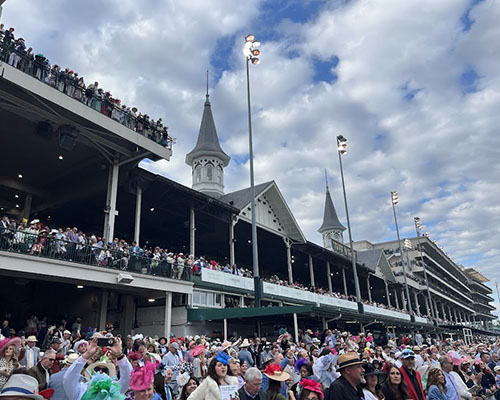
I landed in Kentucky Friday around noon and went straight to Churchill Downs for Kentucky Oaks Day. I got dropped off in a parking lot that seemed to contain every road-worthy party bus in the state. I was reminded of how much the place looked like a NASCAR track with better-dressed fans. It’s surrounded by vast expanses of asphalt on all sides. The most confounding part of the whole place to me is that the vast majority of its infrastructure is really only necessary two days out of the year. Its most famous exterior features, the twin spires, are now overshadowed by a more modern clubhouse and grandstand; luxury accommodations constructed to cater to the needs of the modern-day racegoer. Originally constructed in 1875, it’s now an amalgamation of architectural styles with more rooflines than you could count. Even with all its updates and modernization, there’s something special about being there enjoying the same vices that people did 150 years ago.
I changed into my race-day clothes in a port-a-pot staged for one of the many police forces on site. I met Corbin, Katelyn, and Bridgit at the gate and we waded into the madness. Inside was a sea of plaids and paisleys, seersucker and pinstripes. A kaleidoscope of pastels. Despite all its modernizing and sprucing up, you can still feel the history in the place. We wandered around throughout the day, indulging in light beers and popcorn. We saw a six-time Super Bowl winning coach (now a struggling college football coach) enjoy the races with his much younger girlfriend. We stayed until the end of the 13-race card, placing a few bets and cashing even fewer. Light beers gave way to bourbon as Always a Runner won the first prime-time Oaks under stadium lighting.
Oaks Day turned into Derby Day after an 11 p.m. order of chicken linguine and a few hours of sleep in a hotel across town. On Saturday morning we walked past neighborhood blocks lined with ticket scalpers, megaphone preachers, and unlicensed concession stands. I had a mint julep before noon (several more after noon, too). I spent the middle of the day hoping to see two of my favorite sons of Kentucky, Mitch McConnell and Papa John Schnatter, but had to settle for Rand Paul.
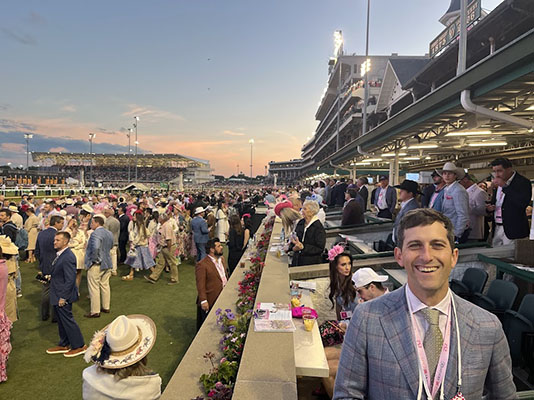
The whole event requires armies of caterers, hospitality staff, bartenders, police, betting tellers, vendors, and the actual army, too. For a sport that isn’t always quite ready for its big moments, Churchill Downs Incorporated runs a pretty tight ship. I commend them for throwing a good party while increasing shareholder value.
We got our loafers dirty later in the afternoon for the walkover with Litmus Test before the big one. It’s a rare opportunity to go from spectator to spectated. It’s also the only way to really grasp the magnitude of the event. No experience in sports really compares to it.
We found our seats next to two chatty twin sisters from Texas who had attended the derby together for 50 years and we could only assume were heiresses to some vast oil fortune. I let myself get a little misty eyed while the horses came onto the track and the University of Louisville choir sang My Old Kentucky Home.
We watched the 18 starters negotiate for position between the gate and the first turn. Jose Ortiz looked like he used Waze to guide Golden Tempo through traffic to catch Renegade at the wire after spotting the field two dozen lengths early. The first female trainer to win the derby would mean good press for the sport. It was difficult to avoid wondering how a deep closer like Fulleffort might have fared in a race where the pace fell apart.
The airport Sunday morning was full of happy, hungover people and women’s hat boxes. I was tired, dehydrated, wondering what was going on back home, but glad I made the trip. Before getting on the plane I bumped into our old boss, Graham, who was on the same flight back to Baltimore. He asked me about fatherhood and we recalled the weekend. I let him know I was still following the instructions he gave me as a teenage kid, sticking with Corbin.
Oldest son of TIHR’s Joe Clancy, Ryan lives in Baltimore with his wife Ilana, son Miller and their dog Churchill. Read more from Ryan on Substack.