Not many jockeys can say they rode multiple champions in 2014. The easy ones are John Velazquez (Untapable, Main Sequence, Judy The Beauty and Dayatthespa) and Victor Espinoza (California Chrome, American Pharoah and Take Charge Brandi). But there’s one more.
Robbie Walsh is the jockey of steeplechase champion Demonstrative and the exercise rider of turf male and older male champion Main Sequence. Walsh, 38, rides jump races on the weekends and rides out for Main Sequence’s trainer Graham Motion at Fair Hill Training Center during the week. Along the way, Walsh wound up associated with two of 2014’s best. It all came to a rousing conclusion at the Eclipse Awards in Florida Jan. 17. Walsh, wearing a tuxedo and smiling, was there as his horses received North American racing’s highest prize.
“It’s a bit surreal when you walk in and you’re amongst who you’re amongst,” he said of the night. “I’m working for Graham Motion. He’s at that top level, but then you look around. One table beside us is Todd Pletcher and his crew, another table beside us is Bill Mott and his crew. Everywhere you walked around you saw people like that. A lot of the jocks I knew from the weigh room at Saratoga, but it was pretty surreal to be there and be connected to horses with as good a chance as they had.”
The Irishman had ridden finalists twice before, but did not attend either dinner. The race was too tight to be sure for Demonstrative in 2012, and Preemptive Strike had no real chance of winning the top prize while racing against the likes of McDynamo. This time, after three Grade 1 wins and $362,500 earned in six starts, Walsh wasn’t missing the moment. He wound up on stage with trainer Richard Valentine and owner Jacqueline Ohrstrom after the announcement for Demonstrative’s landslide win.
Walsh stayed at his table when Main Sequence won his titles, but was no less proud after riding the Flaxman Holdings star almost every morning for the previous six months. Sick with pneumonia when he arrived at Fair Hill Training Center, Main Sequence returned to health and gradually blossomed into a champion.
Walsh played a part in the success of both horses, but laughed when asked to compare them.
“They’re very different horses and the only real way to think about it is if Main Sequence was to ever go jumping which is something that would never happen at this point,” he said. “But even in that sphere, they’d be very different horses.”
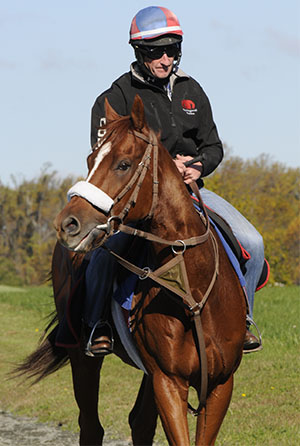 In a very hypothetical jump race, Walsh would ride Main Sequence the same way Rajiv Maragh and Velazquez do in a flat race – with great patience.
PHOTO: That’s Main Sequence and Walsh walking back from a training session at Fair Hill. Maggie Kimmitt photo.
“You would not see daylight until after the last,” Walsh said. “You’d have to be brave enough to be 2 and 3 lengths behind jumping the last, because knowing him and having worked him I know how quickly he gets there. He’d be a very good horse.”
Walsh called Main Sequence “smaller, handier, niftier” than Demonstrative, and drew comparisons to 2004 jump champion Hirapour.
“They’re a lot of fun to ride over jumps, horses like that,” Walsh said. “You just pop around behind people and hope the race doesn’t fall apart in front of you. You know you’ve got gears. If you don’t find the gears on a horse like that you’ve either met one too good and over-jumped it and caused a problem or something’s not right.”
Demonstrative is at the other end of the equine spectrum, a big brute who can overpower riders, rivals and races. He can get strong and be tough to gallop in the mornings, though Walsh rarely rides him then.
“Demonstrative would run off with you in the mornings whereas Main Sequence would not, he’s not that type,” Walsh said. “Demonstrative, you’re constantly going ‘please don’t go, please don’t go, please don’t go’ which is funny because he wouldn’t be near as fast as the other horse. In a training situation he can be pretty lit up. Main Sequence will come up in the bridle, but he’d lob around there most days.”
Demonstrative has learned to settle in his races, but that wasn’t always the case. Walsh would constantly worry about his horse coming to life and using his energy at the wrong time. With maturity, that’s changed and Walsh can place the son of Elusive Quality almost anywhere in a race. Demonstrative can be near the front or out the back, depending on the pace, and quickens when Walsh asks – though it’s usually a far longer run than Main Sequence’s quarter-mile burst. Demonstrative came within a nose of winning four consecutive Grade 1 stakes in 2014, and dominated the $250,000 Grand National (the year’s richest race) in October.
Since Walsh mentioned the remote possibility of Main Sequence as a steeplechaser, he also considered Demonstrative as a flat horse even if it’s been more than four years. Bred by Gainsborough Farm, the Kentucky-bred won once in 11 English flat starts – the last coming at Newcastle in June 2010.
“It was just maturity with him,” said Walsh. “He would want a mile-and-a-half, definitely, but you’d be looking at a Hardest Core type of horse, the relentless galloper type of horse. But I don’t think he’d have the speed to take on the top level.”
Not that it matters. Demonstrative will not enter a starting gate in 2015. Main Sequence won’t get close to a hurdle.
And Walsh, who rode out at Fair Hill before flying to Florida for the Eclipse Awards, will be along for the rides.
###
Hey Robbie Walsh, how has your career as a jump jockey changed over time?
“Going to the races knowing I’ve got three or four horses that are going to run well is a big change. You go racing and you know you’re live. At 38 years of age, that’s nice to have. Those weekends when I was 28, and I was saying ‘I hope I can get one to finish’ were tough. I had one season where I think I had 60 rides and 10 falls. That’s a fall every six rides, a fall almost every weekend. Those are tough days.”