As far as Douglas Scharbauer is concerned, the first weekend in May should happen more often.
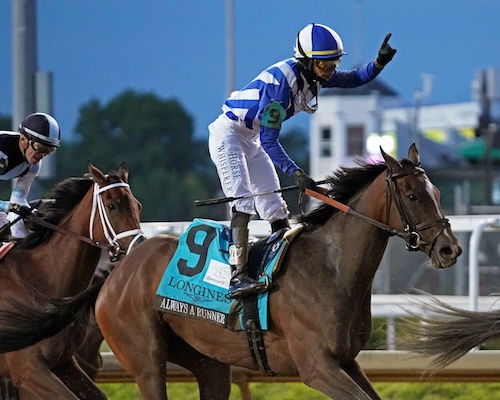
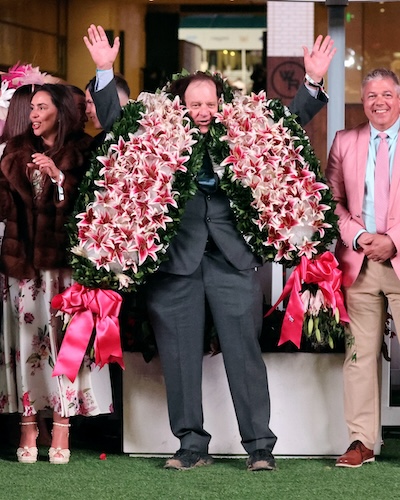
Sixty-seven years after his grandfather won the Kentucky Derby and 39 years after his mother won it, Scharbauer landed in the Kentucky Oaks winner’s circle with Always A Runner – one day ahead of schedule.
“This weekend is very special,” Scharbauer said Friday night, after the first nighttime – more like dusk – running of the Oaks, the 152nd edition. “For my grandfather on my mother’s side, Fred Turner Jr., to win the Kentucky Derby in 1959 with Tomy Lee on May 2, and then for my mother to come back with Alysheba in ‘87 on May 2 … and (Saturday) is May 2.”
Two is relevant for another reason, as in the number of starts Always A Runner had coming into the Oaks, after being sidelined by illness as a 2-year-old last year. Trainer Chad Brown did not get the daughter of Gun Runner started until February 6 at Tampa Bay Downs – a 6 1/2-length win that led Brown to run her in the Grade 3 Gazelle at Aqueduct April 4.
Always A Runner, a $1.05 million purchase at the 2024 Keeneland September yearling sale, responded with a convincing victory that resulted in an 89 Beyer Speed Figure, a 30-point jump from the maiden race. That was all Brown needed to see to take a swing at the Oaks, third start and all.
“She didn’t have to be here,” said Brown, whose Hall of Fame credentials were further cemented with this training job (and stay tuned for Emerging Market in Saturday’s Kentucky Derby). “She could have never run again, easily. I’ve had it happen with several horses. The fact that not only did she overcome it and ended up here today as an undefeated horse in the Oaks is remarkable. I have a lot of nice horses in my care, and I have seen a lot of different setbacks with horses. But this is way up at the top of the list of perseverance for a horse to overcome things. It’s at the top.”
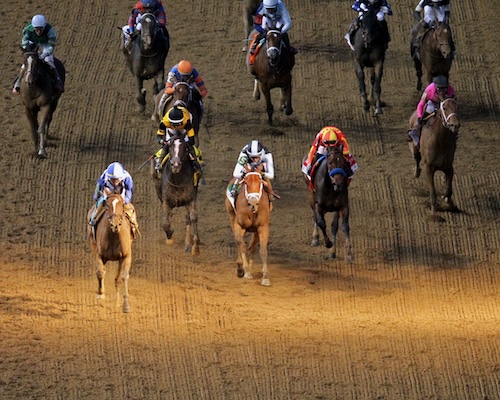
Brown and jockey Jose Ortiz, who won five races on the Oaks card, discussed several possible scenarios on how the race might play out. One was following Meaning, a Michael McCarthy-trained filly from California who figured to be forward and make a move on the far turn. That is just how it materialized, with Meaning advancing from third after 6 furlongs and overtaking the front-running Explora at the stretch call. Ortiz had plenty of horse to run by both, winning by 1 1/4 lengths in a time of 1:48.82.
“It worked out just as we had planned,” Brown said after capturing his first Oaks. “These big races, with big fields, you have to have plans, A, B, C, sometimes D. We never got to plan B, because that’s exactly how we laid it out. And Jose executed it perfectly. And this incredibly talented filly cooperated. She was there for him at every pole.”
Pneumonia had landed the filly in Dr. Rodney Belgrave’s Mid-Atlantic Equine Medical Center in New Jersey last fall, according to Brown, who had to make more than one of those unpleasant phone calls from trainer to owner.
Scharbauer, who sold back 50 percent of the filly to breeder Three Chimneys Farm right after buying her, was on the other end of those calls.
“In the fall when she had pneumonia, this filly was struggling,” Brown said. “She had a severe case of it, and she was in the clinic for over a month. And everyone was patient. We had a wonderful team of veterinarians that helped her get back. We would have never thought we’d be here today when I made that phone call. But, you know, the filly took us here. No one pushed me to run the horse here. It was probably a surprise to the owners that I ended up putting her on track to get here not too long ago. Good horses take you here.”
With horse racing quite literally in his blood, Scharbauer, who owns Valor Farm in Pilot Point, Texas, is well aware of that, which makes him appreciate the job Brown has done with his horse even more.
“This filly with no more than two outs, I mean, with not starting her till her 3‑year‑old year, I just think our trainer, he’s done one fantastic job,” Scharbauer said. “I’ve never seen it happen like this.”
He was happy to not only witness it, but experience it as a third-generation winning owner on the first weekend in May.
Tomy Lee outdueled Sword Dancer to win the 1959 Derby by a nose, while Alysheba, owned by Dorothy Scharbauer, gave Hall of Fame jockey Chris McCarron his first Derby in capturing the 1987 edition. On Friday night under those same twin spires – this time illuminated in pink in keeping with the Oaks Day theme – it was Douglas Scharbauer’s turn, prompting him to reflect on how his late parents would have felt about his first Grade 1 win coming on the biggest of stages.
“They both passed away, but I don’t have any doubt that both of them were certainly watching this from above,” he said. “After she hit the finish line, I’m sure both of my parents were smiling. My father (Clarence) ran Quarter Horses most of his life, and he was president of the American Quarter Horse Association in 1975. But mother, after her father won the Derby in ‘59, she talked my father into coming back to Kentucky and getting back into the Thoroughbred business. Both of my parents, whether it was Quarter Horses or Thoroughbreds, they loved all of it. It’s always been an excitement with me, and it will never change. I love this sport. I just love it.”
Scharbauer made the winning seven-figure bid for the first foal out of the Brown-trained Always Carina that was bred by Goncalo Torrealba and Three Chimneys. Against the advice of his racing manager, Donnie Denton, he agreed to let them buy back in.
“Right after the hammer went down, the people from Three Chimneys were walking over to us,” Scharbauer said. “And Donnie, my manager, was sitting by me and he said, ‘Doug, those guys are coming over here and they’re going to congratulate you and thank you for buying their filly. But I would guess they might ask you if it would be alright with you if they owned half of her. Doug, don’t let them have it. Keep her yourself, 100 percent.’ Well, they came over and they congratulated me for buying her. And then they did ask me, ‘Would you consider selling half of her to us?’ And I thought for maybe 30 seconds, and I wished I’d never said it in a way, but I said, ‘That’s fine, if you want to do that.’ They’re great partners.”
Three Chimneys vice chairman Doug Cauthen is pretty pleased Scharbauer said yes.
“Goncalo Torrealba has always wanted to win the Oaks,” Cauthen said. “He has always said the Oaks was the most important race for him. So, to win this is amazing for Goncalo and for the whole Torrealba family … and this partnership brought us here.”
“Here” was almost 1,000 miles away from Scharbauer’s family farm, which he purchased from his siblings after their parents died. He has two stallions and about 30 broodmares on the 393-acre property about 60 miles north of Fort Worth.
“It’s a well‑run farm in Texas. Nothing like Kentucky, but we’re getting there,” he said. “It’s not that big, but it’s beautiful country. And for Texas, I think it’s as nice a place as I could put Thoroughbreds. My brothers and sister wanted to sell the ranch. And we actually had it on the market for about a year, but if we sold it, we would have sold it for next to nothing. And I just finally told him, I want to buy it. Let’s negotiate something fair to both of us. And we did.”
Brown will saddle a horse in the Derby with a remarkably similar resume. Emerging Market was unraced as a 2-year-old due to injury and illness, broke his maiden on debut at Tampa and is 2-for-2 heading into the Derby.
“If it’s working, we’re going to keep doing it. Two starts and go,” he said. “He’s got a tall order. Obviously, it’s a larger field than the Oaks field. But, still, a horse that has only run twice. You have to really step up like this incredible filly did, give up some experience and have overall raw ability override it. And I’m hoping (Saturday) we can do the same.”