
By Anthony Affrunti
Happy birthday to you, Parx Racing.
And it’s a big one. This year marks the 50th year of racing at the track, located in the Philadelphia suburb of Bensalem.
In 1974 – two years before Rocky Balboa became a Philly icon – Keystone Park was born.
It has gone through several names before it became known as Parx, home to Saturday’s Grade 1, $1 million betPARX Pennsylvania Derby and Grade 1, $1 million Cotillion, the two biggest races on the biggest day of racing outside the City of Brotherly Love.
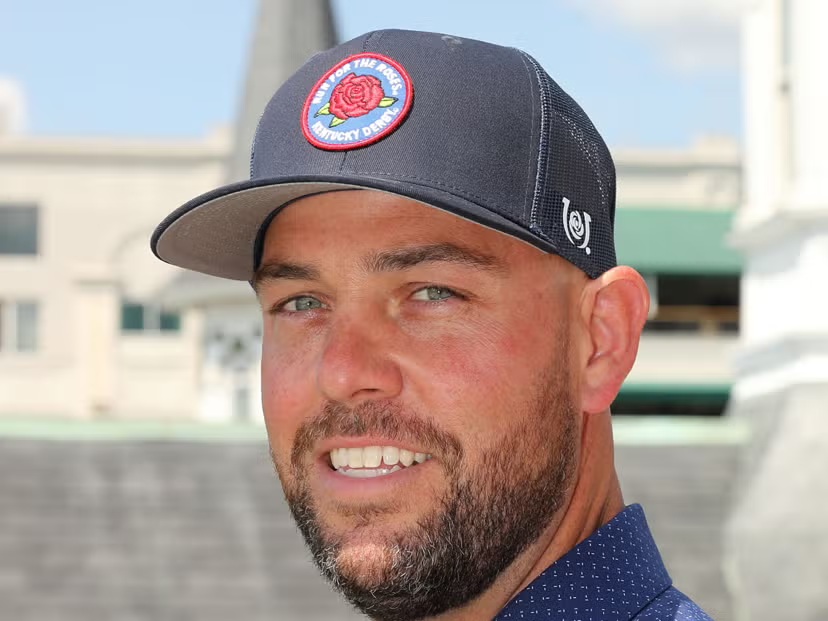
The Philadelphia-born trainer Robert “Butch” Reid Jr., who will send out 11 runners Saturday led by Uncle Heavy in the Pennsylvania Derby, remembers the early days.
“I was actually there that first year,” Reid said. “My brother Mark had just begun training. He was training at the old Liberty Bell, and he moved over to Keystone as it was known the first year. I was just getting out of high school and in college and I was there walking horses and rubbing horses with my brother. I been around off and on for pretty much the whole run of the track.”
Where have the years gone? Reid ventured away for other spots, but always found his way back home.
“It’s been an amazing ride for better or for worse,” he said. “I’ve come and gone several times. We did Monmouth for a few years, and we’ve tried everywhere but we always end up back at the ‘Stone.’ It’s been a good home base. It’s been very good to us that’s for sure.”
Here’s how we got here.
In early December 1972, the Pennsylvania Racing Commission granted approval to both the Continental Racing Association and the Eagle Downs Racing Association to begin construction on what was to become the first major Thoroughbred track in the state called Neshaminy Park, amid 400-acres in Bensalem Township.
Both groups had leased the nearby Liberty Bell Park since being granted racing licenses in 1969 when Thoroughbred racing was introduced to the state. Liberty Bell was primarily a harness track, but the long-term goal of both racing associations was to secure their own facility.
Under Pat Rooney, the son of Art Rooney, owner of the Pittsburgh Steelers and several other racetracks, the Continental Racing Association secured the financial arrangements to meet the $30 million needed to build the new endeavor. Many questioned why the area needed a new racetrack while others thought Western Pennsylvania might be a better location.
The elder Rooney was quoted as saying that Pittsburgh never was a racing town. He stated that Philadelphia was one of the best racing cities in the world. Due to its close proximity to New Jersey and Delaware, the locals were educated in racing. He felt that Philadelphians were known to be much more affluent and was quoted in local newspapers saying, “One bettor from Philadelphia is worth four from Maryland.”
Plenty of work behind the scenes in both political and architectural circles continued as did the construction on the once-vacant land with a target opening sometime in the beginning of November 1974. Many doubted that the new track would open, but John J. Finley, president of Eagle Downs, promised a very functional plant.
“It will be a good-looking track with plenty of room for the fans,” Finley told local newspapers.
After a survey found that many had trouble both spelling or pronouncing the word Neshaminy, and to further avoid confusion with other local businesses such as the nearby mall which would share the name, the racing associations agreed that the new racetrack would instead be called Keystone Park to honor the state’s nickname.
Hard economic times led to speculation that the racetrack would be a tough sell to the $2 bettor as parking, lunch, admission and a racing program would leave the racegoer $10 short before the first race even ran. To circumvent this, track management listed $1 admission coupons in all local newspapers as well as a package with admission, parking and a program for an affordable price of $2.50.
On Tuesday, November 4, 1974, Keystone Park opened its doors under clear skies with a post time of 12:30 p.m. and a nine-race card. A crowd of 14,248 turned out and found more betting windows, ample seating, plenty of parking and a heated glass enclosed structure for the winter that would also offer air-conditioning during the warm summer.
A $3,000 claiming race saw the 3-year-old gelding Motto close under jockey Calvin Stone amid a field of nine others to win the opener by 3 3/4 lengths going away in 1:23 4/5 for 7 furlongs. Total handle on the race was $51,153 and those with win tickets showing the number 2 received $4.80 on a $2 bet.
Since that first day’s total handle $1,237,868, thousands of races and billions of dollars have been won and wagered at Bensalem’s track. A second name change was announced in 1984 when Keystone gave way to being known as Philadelphia Park before a third change to the current Parx Racing in 2010.
Countless races have been won and lost and horsemen have come and gone, but only a few remain on the grounds that can recall the history from Day 1.
When asked to share what his most memorable victory is at the track he calls home, Reid believes that answer lies in the future and he has yet to complete that task.
“It’s always been the PA Derby for me,” he said. “We tried it a couple of times, but that’s one race I’d like to win. We had run second in the Cotillion a couple of years ago with Morning Macha (2022). We certainly won our share of the PA-bred stakes over the last couple of years, but I don’t think there’s one race that kind of jumps out at me over the years. This would be the big one if we can get there (Saturday). That will be the one that stands out.”
Fellow trainer Lou Linder Jr., who will send Just Step On It to the gate in the Derby and eight others on the undercard, is another who remembers the first year at Keystone. Under his late father of the same name, he recalls the old days.
“I got my license in 1977,” Linder said. “I remember coming here with my dad. There were two outfits that were allowed to come in early and unload their horses, J.R. Cowden and Ron Glorioso, who since passed. They were allowed in that first day but the next day when everybody was allowed, we were the third van in.
“I know that there are some grooms that I’ve known for 50 years but I really don’t know their name. I just know them from here. When it was Keystone, it was pretty basic back then, it was bare bones, but the racing was good. We have a good relationship with the track as horsemen here. This place is well run, and we have a lot of really good horsemen here. We really have a good thing going.”